Friday, 29 July 2011

An Antiquated Update

 As previously mentioned, we were in the vicinity of the picturesque little town of Åhus recently. This charming and most respectable little town is rich in pretty houses and gardens, sailing boats, and tanned Swedish people. We found it quaint to the point of paranoia, in a David Lynch kind of way, and kept wondering what goes on behind those charming façades. "All kinds of things", a local assured us.

Paying a visit to the local museum, we were distraught to find that the public toilets were locked and unavailable. However, the charming receptionist very kindly let us use the staff toilet.

We know you're all desperate to see the pictures, and are probably scrolling down without reading this, but we just wanted to note that the Åhus museum is very interesting, and just the right size; it takes about 15 minutes to see everything, and then you can go and have an ice-cream from Otto's ice cream kiosk in the square outside. For those of you who have been to York, you might be interested to know that the medieval artefacts at Åhus museum are quite similar to those at the Jorvik centre. There is even a rosary made with jet (presumably from Yorkshire) as well as amber beads!

A charmingly messy but clean staff toilet

A beguiling little sink

An environmentally friendly and pleasantly scented soap

A first-aid station on the back of the door!

Charming old-fashioned door handle and hasp lock

The shamefully closed public toilets

Åhus museum
Torget
SE-296 31 ÅHUS
Sweden

Related Reading
By the Sea - A Toilet Blogger's Holiday
Jorvik: In Rude Health
The Yorkshire Museum
The Castle Museum

Monday, 25 July 2011

By the Sea - a Toilet Blogger's Holiday

 We've been on holiday. You may have noticed the radio silence. But our regular readers can now cease tearing their hair and sniffing glue to relieve the tedium - we're back! And we have, of course, maintained ceaseless vigilance on the toilet front, to keep you amused and edified.
We found this classic Swedish "utedass", outdoor privy, on the south-east coast just outside Åhus (more on this very respectable centre later on). It's attached to what is now a summer house, but used to be a smugglers' den! We could barely contain our exctitement.


Close-up of the bog, a vintage Porta-Potty!

Pictures of royalty add class and distinction to any loo
Whiling away the time while gazing at these walls must be a pleasure!

A priceless 1950s bookmark collection - Carl XVI Gustaf, top centre, with family
A touch of class


British royalty add glamour

Clockwise from left: Franz Joseph I of Austria and Queen Elisabeth; Fergie and Prince Andrew engaging in a nuptial snog; the Swedish royal family; some chick with a dog; Diana and Charles

Bin, bog roll, wet-wipes

Quality wet-wipes
Since this update is, in a sense, a holiday edition with extra glamour and fun, we've added this little film to make the festive feeling positively riotous:


Festive video - Badliv, By the Sea


Related Reading
An Antiquated Update
If You Like Sheep and Beer: Why Not Go to the Lake District on Your Next Holiday?

Friday, 8 July 2011

Puppies, Bloody Puppies

We ran out of bog roll. Stopping at the nearest supermarket to stock up, we realised to our horror that all they had was Andrex. However, with our recent discovery about their FSC status in mind, we managed to purchase a pack with relative equanimity. We do still wish it was unbleached, but are secretly pleased that this version has a puppy pattern.

Puppies, bloody puppies...

The FSC logo: our sanity saver. Also adorable paw.

Puppy pattern: we love this despite ourselves

PUPPY!!!

Wednesday, 6 July 2011

Coming Soon: Celebrity Toilets!

We are dreadfully excited about a new development for our beloved bog blog.  We have persuaded a real, bona-fide celebrity (we won't tell you who yet) to show us their bathroom!  Expect glamour, expect drama, expect sparkling porcelain!   
We look forward to an update full of intrigue and heated emotions!  So get your fake eyelashes on, and keep your eyes peeled!

Two typical celebrities and a toilet
Image from moopy.

Hypocausts: A Hot Topic!

 We've been talking a lot about Roman plumbing lately. We happen to be lucky enough to live near the remains of a Roman bath, built around 300 A.D., and we thought we'd share some of the loveliness with you.

The Roman underfloor heating works by means of a hypocaust.  The floor is supported by pillars, leaving empty space underneath, which is filled with hot air supplied by a furnace. (Slaves stoke the furnace night and day, for your comfort.) A boiler is also attached to the furnace, providing hot water.
Flues bring hot air inside the walls, meaning the entire structure is heated.  To avoid the problem of condensation on the walls, the Romans developed fiendishly clever wall tiles, called box tiles, designed to leave a space between the inner and outer wall.
For more information see, as ever, Wikipedia.

For your enjoyment, we hereby supply some pictures from the Roman Bath Museum in York:

Part of the frigidarium; the cold bath

The caldarium, or hot bath: you can see one of the wall flues in the bottom left-hand corner

Waterproof concrete, ventilation, and a heating system that works - the Romans knew how to build a bathroom!
For a previous post on the interesting things to be admired at the Roman Bath Museum, click here.

Tuesday, 5 July 2011

Ventilation: Getting Fresh?

Do you keep a can of air freshener in your bathroom?  And is the said bathroom infested with mould?  If you live in Britain, chances are that at least one, probably both, of the above suppositions will be true of you.

Air freshener, according to Wikipedia, contains “formaldehyde, aerosol propellant, petroleum distillates, and p-dichlorobenzene. Air freshener preparations often also include terpenes such as limonene. Aldehydes, ketones, esters, alcohols and other synthetic fragrances are also used. A report issued in 2005 by the Bureau Européen des Unions de Consommateurs (BEUC) found that many air freshener products emit allergens and toxic air pollutants including benzene, formaldehyde, terpenes, styrene, phthalates, and toluene.[2] Air fresheners may also contain phosphates, chlorine bleach, or ammonia” (http://en.wikipedia.org/wiki/Air_freshener).
Do you really want to be spraying that stuff into the air you breathe?

Mould likes damp environments, and seems, in the British Isles, to be a fact of life.  Many are the horror stories we have heard (wait till Halloween and we'll share them!) of plumbers who, when fixing the bathroom, instead of removing mould, have simply covered it up with silicone.  It's enough to make your blood freeze!

Another common feature of British building maintenance is what we usually refer to as the Great Mould Cover-up.  Got some mould in yer bedroom, love?  Get a builder in to paint it a lovely shade of magnolia –  problem solved!  But is it?  Well, no. Wait till winter, when things get a bit damp again, and the mould will be happily sprouting as thick as ever.

Revolting Picture I: Here's the mould still visible behind a heater
after a builder painted over all the other mould with a lovely shade of magnolia
 What's all this got to do with air freshener, then?  Well, the root to all these problems is ventilation – or rather lack of it.  You rarely find ventilation more sophisticated than the “bash a hole in the wall” approach in Britain.  Holes in the wall, as we may have mentioned once or twice before, do not constitute ventilation.  This is why we quite literally filipped, capered and frolicked with joy when we came across a company called Envirovent in our local paper! They supply the kind of ventilation system that houses in many civilised countries have fitted as standard. 

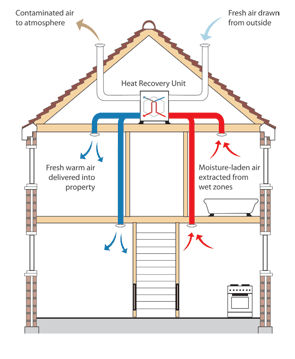
We supply here, for your edification, a diagram of a functioning system of ventilation.  It's got an intake of air, an outflow, and, crucially, a heat exchanger.  This means that the whole house is supplied with fresh air without any loss of heat.  

Picture from http://www.homeventilation.co.uk/heat-recovery.php

Now, isn't that better than that bloody air brick making your living room cold, damp and miserable?

Revolting Picture II: A hateful air brick, or hole in the wall
 Information on household chemicals from the WWF:
http://wwf.panda.org/about_our_earth/teacher_resources/webfieldtrips/toxics/chemicals_affect_you/reduce_your_risks/
More information about cleaning products and hints on avoiding harmful chemicals in the home:
http://www.familiesonline.co.uk/Subjects/Articles/WARNING-cleaning-is-a-health-hazard 
A good place to buy ecological cleaning products is Oxfam.

Footnote:
This all looks like one big ad for the ventilation company, doesn't it? Rest assured that we haven't sold out - we were just genuinely thrilled to see this product advertised!

Monday, 4 July 2011

Thomas Crapper: The Silence of the Toilets


A most amusing little book called Flushed with Pride: The Story of Thomas Crapper, by Wallace Reyburn, has come our way.  It is a real joy to read; full of the most delectable anecdotes.  We don't believe in selfishness when it comes to interesting information regarding toilets, and so we have resolved to share little snippets with our dear readers every now and then.  Today we bring you information on flushing.

Akin to the problem of the recalcitrant chain is the noise associated with the W.C.  A question frequently asked, particularly by women, is:  ‘Why can't there be a really silent toilet?’
Sensitive females, such as maiden ladies and girls entertaining a new boy friend, know it is no good announcing, ‘Excuse me a minute, I'll see if the scones are done’, merely to have the sound of the flushing toilet proclaimed to everybody in the house [...] ‘I have been to the loo.’
Crapper had this problem very much in mind and in those pioneer days of the modern toilet he knew that the noise broke down into these four basic components:
       (a)     The sound of the flush itself, the down-rush of water into the pan;
       (b)   The gurgle which occurs at the end of the flush;
       (c)    The hissing sound of the water coming in to refill the cistern;
       (d)   The noise of water coming under high pressure to the cistern through copper pipes which, to quote an old plumber, ‘ring like a peel [sic]of bells’.
 When Crapper was confronted with the problem of what to do about it all, this water concerto was really con brio.  Thanks are due to him for building in silencers which cut down much of the noise and to which modern water closet makers have added little more in the way of noise elimination.  Crapper's improvements to what became the ‘Marlboro’ silent Water Waste Preventer’ at the turn of the century incorporated two refinements which, if they didn't ‘prevent the hissing and the gurgling’ as claimed, at least minimised it.  Modern inventors have got rid of some of the gushing noise down in the pan, by developing the siphonic trap.  But truly Silent still eludes them and it was cause for worry on a Royal level.
(Pavilion Books Limited, 1969, pp 21-22)


We're afraid we really must leave you at this stage of the story. If you can endure this cliffhanger and live to see another day, you'll get the next instalment soon.


Related Reading
Everything You Always Wanted to Know about Toilet Roll Holders (But Were Afraid to Ask)
Related Posts Plugin for WordPress, Blogger...