Showing posts with label Eco-labels. Show all posts

Thursday, 26 February 2015

More Monkey-Friendly Soaps!

What-ho, what-ho, good folks. Guess what? Sometimes there are unmistakable signs that there is hope for mankind, despite all the previous evidence to the contrary.

We have been busy organising a publicity event for a women's shelter, and have been impressed rather than otherwise by the response from the businesses we have done our damnedest to cadge favours from. All the humanity has brought the roses back to this gnarled old toilet-blogger's cheeks!

Also, we found these lovely soaps from the Danish company Urtekram:

Here is Monkey, posing happily in the sunshine
with a couple of monkey-friendly soaps and his favourite citrus plant.

They smell heavenly of roses and lavender, respectively!

As regular readers are aware, we have certain requirements when it comes to soaps: they must smell nice and they must be monkey-friendly. The devastation caused by palm oil plantations is well known and requires no further description.

Our lovely new Urtekram soaps are certified organic, vegan and not tested on animals, but we couldn't find any information regarding palm oil on the packaging so we wrote to Urtekram to ask. They sent a very polite, very conscientious and very detailed reply, explaining about their palm oil policy [translated from Scandiweigan]:
Our oil comes from both coconut oil and palm oil, depending on what's available. It is RSPO certified , but unfortunately the demand for sustainable oil is greater than the supply. It can sometimes be hard to ascertain whether an ingredient is made from palm oil, as ingredients are broken down into several parts. Here's what our product developer Tom writes on the subject (pardon the Danish):

"Vi har anvendt denne samlende term for de ingredienser for der eksisterer ikke nogen direkte oversættelse fra INCI til normalt engelsk. Det betyder:
vegetabiliska oljeprodukter = polyglyceryl-3 dicitrate/stearate, cetyl alcohol, glyceryl stearate se, glyceryl caprylate, lysolecithin, beta-sitosterol, squalene.

Flere af disse ingredienser kan stamme fra palmeolie, men hvis de gør det så er det Segretated RSPO olie der er anvendt i henhold til de forskellige leverandører vi anvender. Det betyder at vore produkter ikke forårsager fældning af regnskov.

PS Der er en hel del af de ingredienser der anvendes indenfor kosmetisk industri hvor leverandørerne skifter mellem flere forskellige olier – det kan f.eks. være kokos og palme olie, da de har meget ens fedtsyreprofil. Det er på nuværende tidspunkt IKKE muligt at garantere produkter er uden palmeolie – hvis der på et produkt står at det er uden palmeolie, så skal man straks være meget skeptisk – jo sikkert uden palme olie, men mange af ingredienserne er muligvis fremstillet ud fra palme olie!"

We're totally happy with that, and even happier with our gorgeuously scented soaps!

(If you find this sudden effusion of sunshine and roses trying, here's something you can worry and rant about: Antibiotic-resistant bacteria breed in sewers. Remember, also, the multi-drug-resistant gonorrhoea bacteria.)

Let's have a festive video.


Thursday, 14 February 2013

HTFU: Wipe for Wildlife

So this Valentine's Day bollocks has been unleashed again. Millions, if not billions, of people will be spending their hard-earned cash on cheap chocolate and sharing nauseating Victorian sentiments in the belief that they are celebrating love, when actually they're honouring a saint about whom absolutely fuck-all is known except that he died. If the ANZACs were around today, we reckon they'd be fucking spewing. We suggest you HTFU, refrain from buying a load of red and pink plastic tat, and join us in showing some love for the planet!

An article in the Age, sent to us by Australian Friend, alerts us to the fact that Zoos Victoria was running a campaign to encourage the use of recycled toilet paper. Zoos Victoria is quoted as saying:
Millions of trees are flushed down Australian toilets each year, so we can wipe our bums and bits. Zoos Victoria's Wipe for Wildlife campaign encourages the community to help save local wildlife by making the switch to recycled toilet paper and choosing products with the FSC logo. 
However, the campaign was apparently not in agreement with the Baillieu government's timber industry action plan, and hence it could not be supported by Victoria government. Consequently, Zoos Victoria was forced to drop the campaign.

Join us in telling the Victorian government to HTFU!!!

Crapman says "Harden the fuck up, Australia!" Image from the Age.

Related Reading
Random Ranting about Toilet Paper

Thursday, 22 November 2012

Konditori Hollandia: Sumptuous Luxury and Sweet Revenge Go So Well Together

Our faithful readers won't believe this, but Blogspot had the temerity to claim that we had used up our space quota for pictures, and wanted to charge us for using our own blog! Honestly! (For an example of our opinion on having to pay for things which are supposed to be free, read this.) Luckily we found a way around it. We are now celebrating with a veritable cornucopia of dazzling and sumptuous pictures. (In your face, Blogspot!) Many thanks to Logoped Friend for the tip, which went something like, "Oi! Did you know there are Versace tiles at Konditori Hollandia?" Beautifully enunciated, of course. (Yes, you heard right. Versace tiles. And there is an English term for "logoped", but it's so long we can never remember. All we know is, it's not "speech therapist".)

Voilà, here are pictures from Konditori Hollandia in Malmö.


One positively salivates at so much disability-friendly sumptuousness.

One simply couldn't ask for a better toilet.

From Villeroy & Boch: A mixer tap with bells on.

With bells on!


Oooh, sumptuous!

Soap and hand towels from Tork - hurrah! (More info on Tork here.)

It doesn't, so to speak, end there:
Bog roll and toilet seat sanitizer, also from Tork!

We love toilet seat sanitizers. We doubt very much that they contribute to actual hygiene,
but they do satisfy our OCD. Oh yes, they do.

The main event: the Versace tiles! Let's have a collective "Ooooooh"!

And again: "Ooooooh!"


A close-up. Ooooooh.

We weren't quite sure which tiles were supposed to be Versace at first,
so we took a photo of the floor tiles to be on the safe side.

Oh yeah, and the coat-hook was pretty great, too.
We give this toilet about a million points, at a conservative estimate.

Konditori Hollandia
Södra Förstadsgatan 8
Malmö
http://www.hollandia.se

Friday, 24 August 2012

A Calamitous and Inflammatory Blend of Toilet Paper and History

Have family gatherings become boring lately? Everyone being too kind and considerate for comfort? Uncle Lester quit drinking and Cousin Gertrude finally got laid and calmed the fuck down? Well, if that's the case, your problems are finally at an end, thanks to Peta (People for the Ethical Treatment of Animals). Their toilet paper features information about bacterial contamination in slaughterhouses, guaranteed to get everyone riled up and nervous. Uncle Lester will be reaching for the whisky and making aggressive comments about "those goddamned hippies" in no time, and Cousin Gertrude and Great-Aunt Myrtle are pretty much guaranteed to start a heated discussion about the merits of vegetarianism, reinforcing their arguments with broken bottles. 
Stock up on this for the next family get-together (make sure there's a meat course), aggregate a plentiful supply of booze, and you'll be happily feuding for the next decade at least!

Inflammatory bog roll from Peta. Buy it here. Image from Inhabitat

In other news, Andrex, the toilet paper we love to hate, has launched a new Eco toilet paper, made entirely from recycled paper and featuring bamboo fibres. Bamboo "is one of the fastest growing plants in the world producing significantly more fibre, on less land, than trees traditionally used to make tissue paper" says Tom Berry, head of sustainability at Kimberly-Clark EMEA, interviewed by Businessgreen. Bamboo also consumes relatively little water when growing, which is of course great from an ecological perspective.
Asked why Andrex hasn't produced toilet paper made from 100 % recycled fibres before, they reply, "Until now, we were not able to produce a recycled toilet tissue that we were happy with in terms of the quality and softness consumers would expect from market leaders Andrex". Andrex are also anxious to reassure consumers that bamboo is "safe for use in toilet tissue". Naturally, one would expect people to be worried about the effect of a rough, alien fibre on their soft, pampered bottoms.

We still don't get the obsession with soft toilet paper. We really. Really. Don't get it.
That hateful puppy. Image from The Guardian. Illustration: www.jonathan-e.com

 Just thinking about that stupid puppy makes us all irascible. Let's contemplate some soothing historical toilet facts before someone gets hurt!

Blogger Bukisa writes,
The so-called "Room of the Seven Sages", in Ostia (the harbor city of Rome) has painted walls, depicting seven of the greatest Greek philosophers, with ironic texts about their bathroom activities, such as "The cunning Chilon taught how to flatulate unnoticed" and "No one will give you a long lecture, Priscianus, as long as you use the sponge" (the sponge was the Romans’ equivalent for toilet paper).

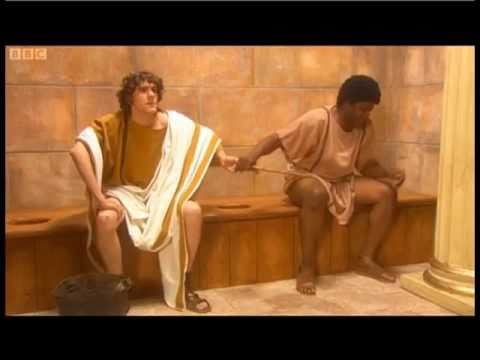
Roman toilet goers. Image from I.ytimg

 For more information about lavatory sponges, and an unforgettable image of the assistant curator at the Roman Bath Museum in York wielding one, look no further.

John R. Clarke expostulates, in his book Art in the Lives of Ordinary Romans: Visual Representation and Non-elite Viewers in Italy, 100 B.C.-A.D. 315 (Berkeley: University of California Press, 2003):
The tavern paintings in the Caupona of the Baths of the Seven Sages at Ostia Antica date to about 100. [...] The artist attributes absurd bowel-movement techniques to the venerable voices of wisdom, the Seven Sages of the seventh century B.C., and he pairs their images with those of ordinary men in the act of shitting.
[...] On the right (west) side of the same wall follows Thales of Miletus, framed by the Greek words thales and meilhsios. [...] Here too, the artist has written the joke in Latin above the venerable sage from Miletus: Durum cacantes monuit ut nitant Thales, or “Thales advised those who shit hard to really work at it.” There is a fragmentary inscription below the Sage that includes the words [u]taris xylosphongio, or “use the sponge on wood”; since Romans used sponges to clean themselves after defecation, one scholar proposes that the phrase suggests using the philospher’s staff for this purpose.
(p. 170)
Let's have some proper, scholarly, linguistic musings as well.

We found a pretty hardcore history blog called Laudator Temporis Acti. The author writes, quoting a play by Aristophanes:
XANTHIAS: Hey, what's happened to you?
DIONYSUS: "The bowel is empty [ἐγκέχοδα]: call upon the god!"
XANTHIAS: Get up, won't you, quickly, you ridiculous fool, before anyone else sees you!
DIONYSUS [rising]: I feel I might faint. Give me a sponge [σφογγιάν] for my heart.
XANTHIAS [producing a sponge from the luggage-bundle and offering it to Dionysus]: Here, take it. [Dionysus lifts his clothes with his left hand; his right hand, holding the sponge, disappears behind his back.] Where is it? [Moving round behind Dionysus, and seeing that he is in fact using the sponge to wipe his bottom.] Ye golden gods! is that where you keep your heart?
DIONYSUS: Yes, it was frightened and slunk down into my lower abdomen.
XANTHIAS: You're the most cowardly god or man alive!
DIONYSUS: Me? What do you mean cowardly, when I actually asked you for a sponge? No other man would have done it!
XANTHIAS: What would he have done?
DIONYSUS: If he was really a coward, he'd have just stayed on the ground smelling his own stink. Whereas I, I stood up, and what's more, I wiped myself clean [ἀπεψησάμην].A sponge, when used for this purpose, was sometimes attached to a stick.
The Greek word for a sponge on a stick is ξυλοσπόγγιον (xylospongion), from ξύλον (xylon = wood) and σπόγγιον (spongion = sponge). The Greek lexicon of Liddell, Scott, and Jones gives only a single citation, Hippiatr.69,100. This is a reference to vol. 1, pp. 69 and 100 of E. Oder and C. Hoppe, edd. Corpus Hippiatricorum Graecorum, 2 vols. (1924-1927), which is unavailable to me. According to Herbert Chayyim Youtie and John Garrett Winter, Papyri and Ostraca from Karanis. Second Series (Ann Arbor: University of Michigan Press, 1951) = Michigan Papyri, Vol. VIII, p. 39, in these veterinary texts the word means 'a sponge attached to a stick for the purpose of applying medicine to open sores.' I do not find this word in the Poorly Attested Words in Ancient Greek project at the Università degli Studi di Genova.

Toilet-scene still from Spartacus, featuring a sponge on a stick. Image from Popclassicsjg.

 We at the Privy Counsel tend to avoid Latin texts like the plague, preferring more unwashed Germanic languages. Luckily, Laudator Temporis Acti satisfies our hunger for dirty barbarians, continuing:
Without using the word xylosphongium, Seneca (Letters to Lucilius 70.20-21, tr. Richard M. Gummere) obviously refers to a sponge on a stick in this gruesome tale of suicide in a latrine: 
For example, there was lately in a training-school for wild-beast gladiators a German, who was making ready for the morning exhibition; he withdrew in order to relieve himself, - the only thing which he was allowed to do in secret and without the presence of a guard. While so engaged, he seized the stick of wood, tipped with a sponge, which was devoted to the vilest uses [lignum id quod ad emundanda obscena adhaerente spongia positum], and stuffed it, just as it was, down his throat; thus he blocked up his windpipe, and choked the breath from his body. That was truly to insult death! Yes, indeed; it was not a very elegant or becoming way to die; but what is more foolish than to be over-nice about dying?
Well, quite.

Dirty Visigoths sacking Rome. Hygeia clears her throat
at the sight of so much naked flesh. Image from the BBC.

Further reading:
The Roman Bath Museum - Crap on a  Stick
Nunc Est Lavandum - Bath-time

Let us Wash, for the Germanic Hordes May Appear at Any Moment
The Finer Points of Roman Hygiene
The Historic Toilet Tour of York  
Our previous post on charity toilet paper
Caroline Lawrence's blog posts about Roman toilets: here and here.


It's not easy being a dirty, filthy barbarian. Image from Chronicle.

Sunday, 18 March 2012

Privy Counsel Family Values

You will be relieved to know that the risk of us running out of bog roll here at the Privy Counsel is, for the moment at least, significantly reduced. We went shopping with Canadian Friend yesterday, and were delighted to find this ENORMOUS pack of toilet roll - 24 rolls for £8! Luckily, Canadian Friend has a car...

We are not overly enamoured with the Sainsbury's own-brand toilet tissue - it's bleached and comes in unpleasant colours. But at least it's FSC-marked.

Just as George the Prince Regent enjoyed enormous trousers,
so the Privy Counsel enjoys enormous packs of bog roll

Saturday, 15 October 2011

Toilet Paper - It's Time to HTFU!

   We have been waxing lyrical about the Forest Stewardship Council label on numerous occasions, even admitting that Andrex toilet paper might not be wholly evil, since it is allowed to carry this prestigious label.
  However, and this is bloody crucial, the FSC label is not the same thing as an eco-label.  In order to be branded with the FSC tick, a product must adhere to regulations governing forestry procedure,ensuring that recycled fibres are used, trees are replanted, and forests generally managed sensibly. So far, so laudable. But it is perfectly possible to fill all the criteria demanded by the Forest Stewardship Council, and then go and treat your toilet tissue with all kinds of horrible and unnecessary chemicals.

So if you insist on buying toilet paper that has been treated with shea butter, or aloe vera, or any other of the countless and evil ingredients that toilet paper companies try to convince you that you need (not that shea butter or aloe vera are evil in themselves, but you didn't seriously think that Andrex put pure, unadulterated-by-chemicals shea butter on their bog roll, did you?), you are contributing to some serious polluting of water and buggering-up of ecosystems.  

Your bum does not need shea butter toilet paper! The human arse has evolved for countless generations to cope just fine without aloe vera.

Image from
  British toilet paper is pretty pathetic, compared to other European brands. On http://www.eco-label.com you can search for products and brands, to see which ones have been awarded the EU eco-label. The only British tissue companies featured on the list are Waitrose (whose toilet tissue is made by Georgia-Pacific) and Disposables UK. The Swedish company SCA dominates the list, but other companies, like Celtex from Italy, Novatissue from France, and van Houtum, from the Netherlands, also feature impressively. Clearly, it is not impossible to make toilet paper that doesn't damage the environment. Tork, makers of tissue and hygiene  products, have the EU label on a significant amount of their products, and, what's more, make one of our featured toilet roll holders! Tork are owned by SCA.

The Green Swan is the Nordic eco label. Their criteria for tissue paper are published here. They look pretty hard-core - as they should do!

Image from

  So come on - as Chopper Read would say: Get some unbleached toilet paper and Harden The Fuck Up! And if you're feeling really hardcore, go for some historical toilet paper!

Saturday, 3 September 2011

Everything You Always Wanted to Know about Toilet Roll Holders (But Were Afraid to Ask)

We have received queries regarding our fierce obsession with covered toilet roll holders.  “Why,” the cry goes, “must they be covered?” “At home,” it goes on, “I just leave my bog roll lying around – is that wrong?”

Is this wrong?

 To explain our viewpoint on this matter, we shall once again escort you into the realms of literature, and reach for our favourite book, Flushed with Pride: The Story of Thomas Crapper by Wallace Reyburn (Pavilion Books, London, 1989).

“An interesting thing to note is that Crapper and other plumbers of his day lay themselves open to infection not only by direct contact during the course of their work [more on this in an upcoming blog update].  Crapper, perforce, spent a great deal of time flushing toilets, and one learns from a recent issue of Lancet that the water closet is a fine example of an aerosol.
Not visible to the naked eye, the spray sent out by a toilet has given hospitals cause for concern and in 1966 The Lancet carried a report on tests made in connection with the fact that ‘flushing a wash-down water closet produces a bacterial aerosol’.
[...] After the slit-samples were incubated for 24 hours, not only was the disturbing fact revealed that the average wash-down closet had sent out 37.5 colonies of bacterial contamination per 100 cubic feet.  Tests made with the seat cover down resulted in ‘a rather surprising finding’.  Far from the seat cover blocking the spray, the number of bacterial colonies jumped from 37.5 to 46.9.  Apparently the spray was forced out through the gap the rubber buffers create between the seat and the rim of the pan and this made the toilet into a much more efficient aerosol, like turning the nozzle of a hose to ‘jet stream’.
All of which makes a nice new thing for anyone with a contamination complex to worry about.” (p. 28)

Our favourite work of literature

Mr Reyburn’s is not the only brain to tackle this problem.  An online article by Sarah Tan gives us more information.

“[The aerosol effect] seems to have first been brought to light by University of Arizona environmental microbiologist Charles Gerba when he published a scientific article in 1975 describing bacterial and viral aerosols due to toilet flushing (2). He conducted tests by placing pieces of gauze in different locations around the bathroom and measuring the bacterial and viral levels on them after a toilet flush, and his results are more than just a little disturbing.
First is the confirmation of the existence of the aerosol effect, even though it is largely unrecognized. 'Droplets are going all over the place—it's like the Fourth of July,' said Gerba. 'One way to see this is to put a dye in the toilet, flush it, and then hold a piece of paper over it' (8). Indeed, Gerba's studies have shown that the water droplets in an invisible cloud travel six to eight feet out and up, so the areas of the bathroom not directly adjacent [to] the toilet are still contaminated. Walls are obviously affected, and in public or communal bathrooms, the partitions between stalls are definitely coated in the spray mist from the toilet (1). Also, toilet paper will be cleanest when it is enclosed in a plastic or metal casing; after all, it's subject to the same droplets splattering on it, and its proximity to the toilet bowl makes contamination potential obvious.

[...] There are also greater implications from the study of the aerosol effect than [the] simple grossness factor. Most obviously, bathrooms should be cleaned even more meticulously than before, with emphasis not just on and around the toilet, but equal emphasis on all areas of the bathroom because all areas are equally affected by the spray. Using the right cleaners is important because all-purpose cleaning solutions are not necessarily antibacterial, whereas most cleaners made specifically for restrooms are referred to as disinfectants or germicidal cleaners (1). Given that the sink area teems with bacteria, one must now be more careful about washing hands properly after walking into the bathroom for any non toilet-related purposes like washing your face and brushing teeth. Using a hair dryer can potentially be problematic in regard to bacteria counts because the effect would be largely the same as hot-air hand dryers, which actually increase the bacteria on hands by 162 percent, as opposed to paper towels, which decrease them by 29 percent (7). If you're still not convinced that bacteria exist in any significant quantities on your hands, consider that [the] kitchen sink actually harbors the most fecal matter in the average home, carried there by unwashed hands after using the bathroom (5). A tablespoon of bleach in a cup of warm water on the offending sink will fix the situation ... for the day.
To limit the scope of the aerosol effect, the simplest method is to close the lid on the toilet every time before flushing (5). This would also provide the peace of mind that while you are washing your hands for 30 seconds, microscopic, bacteria-laden water droplet[s] will not be descending upon your person. Unfortunately, most public toilets, including the ones in Bryn Mawr's dorms, don't even have lids for that option. Besides, given the large number of people who have used the toilet before you, it probably wouldn't make much difference. After washing your hands, use a paper towel to turn off the faucet and to open the door to leave, in order to avoid being recontaminated (4). And today, get a new toothbrush and always, always keep it in the medicine cabinet or some other enclosed place after use (2).” (http://serendip.brynmawr.edu/exchange/node/1839)

 We imagine that quite a few of you, dear readers, are now paralysed with fear, and vow to a) have a colostomy pronto and never, ever, ever go to the toilet again, and b) ditch your best friend and start a deep and meaningful relationship with your hand-sanitizing gel.
However, there is no need to panic!
Hygeia, our patron goddess, has several handy hints and tips for dealing with your increasing toilet paranoia. We shall attempt to outline them in a handy list, easy to read even for hyperventilating, panic-stricken recent hygiene-obsessives.

Print This out and Put It on Your Fridge 
(Or, even better, have it tattooed on your forehead for the benefit of the hygienically challenged)

1) Wherever possible, put down the lid when flushing.
2) When installing a toilet roll holder, make it a covered one.
3) If possible, keep your toothbrush in a bathroom cabinet.
4) Don't bloody use hand-dryers!!! (Unless, of course, they're of the hygienic, Privy Counsel-approved variety (see below).)
5) Wash your hands.
6) Wash you hands.
7) Wash, and we really can't stress this enough, your hands.

(Information on how to wash your hands properly is available here.)

So what kind of toilet roll holder should one go for? Some of our personal favourites come from the Lake District, parts of which are laudably hygienic. For instance, Café Treff, home of the best toilet in England, has a toilet roll holder from the Swedish company Katrin, whose products have been awarded both the Scandinavian eco-label The Swan and the EU Ecolabel.


The Café Treff bog: a pattern toilet!

 Another good toilet-roll holder is situated not far from the best toilet in England, in the Hiker's Bar toilet at the Old Dungeon Ghyll pub, Langdale, which we reviewed the other day. It is the hygienic Smart One holder.

A commendably hygienic toilet roll holder

We also recommend, as an alternative to traditional air-dryers (paper towels are great but not particularly tree-friendly), the new hygienic, energy-saving ones. Two examples that we have come across are the Dyson Airblade and the Veltia Hand Dryer.


Woof! Fancy getting your hands on this one? Enjoy the toilets at Kennedy's in York!


To rub against this baby, get yourself down
to the Berrick Saul building at the University of York!

We hope that you now feel informed, reassured and hygienically competent. (If not, don't hesitate to e-mail us at theprivycounsellor@gmail.com.)

Related Reading
Thomas Crapper: The Silence of the Toilets
Thomas Crapper Day Greetings from Winchester
A Study of the Correlation between the Extremely Scary Toilet Aerosol Effect and Acute OCD in Toilet Bloggers

Wednesday, 12 January 2011

Café Treff, Ambleside: The Best Toilet in England!

 Café Treff is a gem of a café, situated in the centre of Ambleside. We have long regarded the toilet here as the best in the country.

We have been coming to the Lake District for years but, not being enthusiastic to the point of hysteria about trudging up hills in hail storms, pouring rain, blizzards and various other unpleasant phenomena caused by the weather gods' tantrums, we tend to end up enjoying the friendly atmosphere of this very cosy establishment instead.

The cheesy vaseline effect on the camera lens is actually caused by cold, wet weather

According to the website, the pleasant, light interior, rich in natural wood, is explained by the owners' wish to recreate the feel of an Austrian café. This is a welcome sight in a country populated almost exclusively by people suffering from a pathological inability to abstain from ruining perfectly good wood by applying a variety of ghastly stains and paints.

The toilet, like the rest of the café, is light and airy. The tiles are white and extremely clean, as indeed are the toilet and the sink.

So clean! And look - oh! joy of joys! - a mixer tap!
A laudable eco-consciousness governs the fittings: a motion sensor turns the lights on as you enter; the excellent mixer tap has a water-saving airstream, still rare in Britain; the paper towels are strong, which fact, combined with a clever dispenser, reduces the need or indeed ability to use too many; and the bin bears a notice saying the contents are recycled. All highly commendable!

An excellent paper-towel dispenser


Nappy users go home!


The soap is pleasantly scented and comes from a Katrin dispenser, like the toilet paper (which is plain white). Most Katrin products have been awarded the Green Swan eco label.


A totally gratuitous picture - pure titillation!

More gratuitousness. The design of this tap is somehow reminiscent of Battlestar Galactica!

Unfortunately there is no coat-hook, but on the other hand the door opens outwards, which means that it is easy to open without touching!

Points: 9/15

Cafe Treff
Central Buildings
Ambleside
LA22 9BS
Telephone 01539 431027
http://www.cafetreff.co.uk

Related Reading
Advent Adventures: A Revolutionary New Look at the Best Toilet in England
If You Like Sheep and Beer: Why Not Go to the Lake District on Your Next Holiday?

Monday, 29 November 2010

I Never Promised You a Rose Garden, But Here's a Picture of a Lovely Soap


Rose gardens are regrettably few and far between, but at least here's a rose-scented soap to help you pretend you are in one! This is by far our favourite soap; it comes in an ergonomically sound and aesthetically pleasing bottle, it smells of roses, and it's been awarded the Scandinavian eco label, the green swan.

We've got a few exciting reviews up our sleeve, but it's currently too cold to pull them out. Let us content ourselves with noting, that heeding the call of nature while out in said nature (for instance while running 16 km in the snowy Yorkshire countryside with a toilet-obsessed acquaintance), is a cold business.
 If possible, stay indoors, and remember to wash your hands!

Wednesday, 20 October 2010

The Yorkshire Museum


The Yorkshire Museum was reopened in August after extensive renovations. As is becoming well known, the museum itself has caused widespread disappointment and depression among medieval scholars. However, the new toilets are a joy to behold, and warm the heart of a cynical toilet critic.

Starting with the toilet itself, it has a water-saving flush, which is easy to operate without strong mechanical force. The loo roll holder is hygienically covered, and the toilet roll is plain white. There is a coat hook inside the cubicle, which is sturdy enough for a rucksack. The bin is clean and doesn't press unpleasantly against the thighs when sitting down. The cubicle is very clean. 
Moving on to the tap, it  is photo-cell operated. The water is pleasantly warm. The soap doesn't have a pleasant scent, being unperfumed, but perhaps that is all to the good, bearing our allergic friends in mind. There are only air dryers.  On the whole, the toilets are extremely clean and pleasant. It is not possible to exit without touching the door handle.

Points: 11/15.

Visited 18 October 2010.

Yorkshire Museum & Gardens, Museum Gardens, York, YO1 7FR T: +44 (0) 1904 687687
http://www.yorkshiremuseum.org.uk

Related Reading
The Castle Museum
Historical Toilets, Baths and Kitchens - a Useful and Humbling Lesson
A Metaphorical Vitamin Injection
An Antiquated Update
Related Posts Plugin for WordPress, Blogger...