Showing posts with label Sewers. Show all posts

Monday, 11 April 2016

Love, Politics and the Revolution

Did you hear that? That was the sound of us exhaling, immediately followed by the sound of us glugging wine in an unrestrained manner.

As we hinted the other week, in an annoyingly cryptic fashion, things have been pretty provoking of late. But today, lo and behold, we find ourselves, not perhaps stomping our boots uproariously and waving balloons, but at least wiggling our toes pleasurably and winking roguishly at postmen. Also we've had some rather encouraging news which made us inclined to consider engaging in an activity not dissimilar to breakdancing.

We are not, furthermore, the only ones in a genial mood. Our contact at the sewage treatment plant in Källby - that queen among sewage treatment plants - went there this afternoon, to indulge in some sludge inspection, or a similar happy activity. She had to wait for a bit for the person she wanted to speak to as he was busy. However, the jovial sewage engineer then treated our friend, as if to make up for the wait, to an impromptu memory cavalcade about said sewage engineer's childhood, including tales of going to Denmark to buy sugar, or possibly beets.

(We are rather jovial ourselves at the moment, being wined up to the gills, and can't quite remember what the Danish produce in question actually was, only that in those days you apparently got 100 Danish kronor for only eighty Swedish ditto - a fairly fascinating factoid for a Monday night.)

As if to complete the general feeling of geniality, Audiologist Friend has sent us pictures of a lovely unisex toilet in Luleå! She writes:


Dags att visa upp det moderna Luleå. Det nyrenoverade badrummet i Smedjan är den perfekta mellanlandningen efter en förmiddagspromenad på isvägen, på vägen hem.
Jag vet att du inte är ett fan av unisextoaletter men var ändå tvungen att fota och skicka till dig.
(Time to demonstrate the modern Luleå. The newly renovated bathrooms at Smedjan [a shopping centre] are the perfect stopover after a forenoon-walk on the ice road, on the way home. I know you're not a fan of unisex toilets, but I still had to take photos and send them to you.)


As regular readers are aware, we are deeply committed to protecting the rights of transgender people. However, we have a massive problem with unisex toilets, at least if they are designed wrong. We love sharing a toilet with transgender people, and fully understand the dilemma of having to choose one of two gender-assigned doors, when one doesn't identify with either gender, or not with the gender one most resembles physically.

However, we do not, under any circumstances, want to share a public toilet with cis men. (Especially not if said cis men are bearded hipster dudes, as reported previously in a tale of spine-chilling horror.) This means that, if a unisex toilet is designed in such a way that women have to share a space, including the space by the sink, with men, then we are against it.

We have never felt threatened by a transgender person. However, we have often felt threatened by cis men. We are of the opinion that public toilets should be safe spaces, where a woman may let her guard down without being threatened, assaulted, sexually harassed, or mansplained at. A unisex toilet with a sturdy, lockable door, noise insulation (all toilets should have this anyway), and its own sink, is perfectly fine by us. A unisex toilet with uncomfortable stalls and shared, mix-gender sinks will be hated by us until the sun explodes and turns the Earth into tiny specks of dust.

We have mentioned, in a previous post, the sheer evil of certain American politicians, depriving transgender people the use of public toilets due to a professed concern for women's safety. As it turns out, reports Patheos, the number of transgender people to have been arrested for sex acts in bathrooms in the States is currently zero. The number of Republican senators to have been arrested for sex acts in bathrooms is three.

Committing a (presumably consensual) sex act in a bathroom is obviously not the same thing as committing an act of sexual violence, but we maintain our stance that the most common danger to women and children is cis men, i.e. normal dudes.

This unisex toilet looks like it might have its own sink behind a lockable door,
making it an acceptable option, unisex-toilet-wise.

A friendly and welcoming, and hopefully privacy-shielding, screen.

This picture gives us the jitters. WILL WE HAVE TO SHARE THIS SINK WITH BEARDED HIPSTER DUDES? is what we are asking ourselves. Hopefully there is a separate sink behind each of those doors.

We have a treat for you, Festive Video-wise! We went to our favourite rock'n'roll club, Rock'n'rollklubben in Lund, the other night, and had the very great pleasure of seeing and hearing a band called Amaroka. They had come all the way from Belarus! And they kicked arse! (We have some rather splendid photos from Rock'n'rollklubben to show you, by the way, in the near future.)

Amaroka represent "positive punk rock" and their songs, as far as we can tell, are 50 % about love, and 50 % about politics and the revolution. Amaroka in fact played in Kiev during the Ukrainian revolution, and were consequently banned by the Lukashenko regime.

The following video kicks arse on so many levels one loses count - it features a dog, a girl with awesome eyeliner, and a young man flipping pancakes! Enjoy! (We also enjoyed this song, and so did our mum.)


Festive video - Amaroka, Разрываеш

Related Reading
Our rant about the word forenoonHigh Noon, Hell, and High Water - A Very Long Linguistic Rant
Our rant on why we don't like unisex toilets, if designed wrong
Our review of a unisex toilet we really liked, at Bee Bar in Malmö
Our classic rant on mansplaining
All posts featuring Audiologist Friend

We usually feel compelled, when ranting about the patriarchy, to point out that we have many male friends who would never dream of acting in a sexist or boorish manner. Some of them may be found featured under the following labels (in alphabetical order):

Bogsley Hansson Friend
Czech Mate

Thursday, 19 November 2015

Poetry in Motion - We Visit a Sewage Treatment Plant! | World Toilet Day 2015

We trust you've had your Thursday afternoon pub session and are ready to get it on with World Toilet Day without further preamble. Indeed, as Kick-Arse Suffragette Friend pointed out, today is not only World Toilet Day, but also International Men's Day! As we all know, it is important to give International Men's Day the attention it deserves. All that business of getting higher wages, getting promoted without any extra effort, and dominating leading positions in politics and finance worldwide must be EXHAUSTING. Give it up for the world's men, everyone!

Joking aside, more people have a mobile phone, these days, than a toilet. Not having access to a toilet leads, as regular readers should be well aware of by now, to a high risk of contracting several very unpleasant and dangerous diseases. For women, not having access to a toilet can also mean being at greater risk of being raped. As if that risk weren't great enough already.
As Jezebel writer Jia Tolentino says:

I spent a year living with a cell phone but no toilet once. Coincidentally—as coincidentally as the coincidence of [World Toilet Day and International Men's Day]—that was also a year in which I became extremely afraid of men.

In other words, the causes of hygiene and gender equality are intertwined - both are vital to human health and happiness!

In the interest of highlighting World Toilet Day, two of our intrepid correspondents braved the inclement weather and went to the sewage treatment plant in Källby, outside Lund, today! They were treated to an excellent and highly informative tour by a rampantly intellectual guide called Hanna! Hurrah!


No trip to the sewage treatment plant is complete without getting lost in the wild and savage woods surrounding Lund. Here's how happy our brave contributors were to find a sign saying "Reningsverket"!


The first part of the sewage treatment is getting rid of large objects by letting the sewage pass through a three-millimetre grid. After that, the sewage runs into these tanks, where grit is allowed to sink to the bottom and eventually get carted away and used for construction.


Things you should never, ever flush down the toilet include pantyliners. Like the one seen in this positively poetic picture showing November sunlight reflecting off some sewage!

Other things you should definitely not be putting down the bog are condoms. Apparently the inhabitants of Lund are more than averagely festive, and discard a fair few this way! (Don't get us wrong - condoms are an important tool in the battle against venereal disease. Like for instance our favourite disease syphilis or, to pluck a disease at random, genital herpes. But don't flush them down the damn toilet!)

More poetic sunlight reflecting off the tanks. We might have remembered what happens in these ones three hours ago, pre-pub, but now we're pretty much fucked, memory-wise. (At some point iron (III) chloride is added to the proceedings, which makes for a festive atmosphere down at the sewage treatment plant. It is definitely not here, however.)

Woof! "What happens here?" you might be asking yourself. A more adequate question would be, "What DOESN'T HAPPEN?" As far as we remember, bacteria live in these aerated tanks, and do unspeakably exciting things to phosphorus! WOOF!!!

Something else happens here. Possibly a certain amount of litres of water pass through this bit of the plant per minute. There was a mighty roar!

SLUDGE!
This is the final product and, if we remember what our knowledgeable and rampantly intellectual guide Hanna told us, this sludge is Revaq certified and can be used as fertiliser. The tank itself looks like something out of Dante's Inferno. (DON'T DROP YOUR PHONE HERE.)

SLUDGE!


Somewhere in the vicinity of this giant white cylinder, biogas is extracted. For instance, many of Lund's festive green buses run on biogas.

A Privy Counsel representative with our knowledgeable and rampantly intellectual guide, Hanna!


We spent a long time trying to think of a suitable Festive Video, possibly one illustrating a concept such as sanitation, handwashing, or non-violence. Unfortunately, however, we preceded our visit to the pub with a visit to the blood donation centre at the hospital (this is a Very Bad Idea, by the way - one should never, ever consume alcoholic beverages after giving blood), and we've been a bit unfocused ever since. So we're going to go with this song, simply because we think it's awesome. We could all do with some Marvin Gaye getting it on - just DON'T FLUSH CONDOMS DOWN THE TOILET! And remember that no means no! (And an absence of a rampantly enthusiastic YES! also means no.)


It seems wrong to NOT put rum in this mug!
In semi-related news, here's how one Privy Counsel member saw fit to celebrate World Toilet Day - with rum, and Caitlin Moran merchandise, in a glorious combination! Right on, sistah!
(As many of you know, Caitlin Moran sells awesome stuff for the benefit of Refuge, one of the many women's shelter organisations. (If you're feeling intellectually motivated, ponder for a moment why it is that there are so, so many women's shelters in this world.))


Festive video - Charlie Puth, Marvin Gaye

Related Reading
All posts featuring World Toilet Day

One of our favourite Toilet Day posts ever, featuring a rampant Australian talking passionately about methane gas

Information about World Toilet Day from Water Aid

If you have access to clean water, celebrate by joining the conga line in the Cholera Babe Parade!

Caitlin Moran's merchandise for the benefit of Refuge

The Refuge webiste

The sewage treatment plant in Källby


Wednesday, 23 January 2013

Czeching in at Hotel Jalta

One of the Privy Counsel's most die-hard fans sent us these photos from the fabled city of Prague. This very stylish (if ever so slightly blurry) toilet can be admired in the restaurant at Hotel Jalta.

This looks nothing short of fabulous

We find these types of hygiene certificate extremely soothing
 If you're heading to Prague, we recommend a visit to the Ecotechnical museum, being the place to go if you're into sewers! Prague Guide UK tells us that,
The museum is there to show off the Czech ability to understand civil engineering better than most other countries in the world. To do this, it shows off the designs – created one hundred years ago – for Prague’s sewer system. Walking through the sewage system itself is a wonder of engineering and will have you stunned. There are long channels and huge chambers, as well as brickwork that you would usually associate with a Gothic cathedral above the ground. There’s even a large engine room, which is a real boon for those with an interest in old engines and associated matter.
It might surprise you to know that the sewage system of Prague has played a massive role in the way that the city has developed. Like many cities one hundred years ago, Prague was plagued by illness and disease, mainly because the residents still used the river as their source of water. With the population growing at an alarming rate, these sanitation problems only grew worse – until the sewage system was introduced.
When the sewage system was introduced, the city almost immediately became more sanitary and a lot healthier. In fact, it allowed Prague to become one of the best regarded cities in Europe. The design for the sewer was conceived by an Englishman by the name of William Heerlein Lindley and construction began in 1896 – it was finished nine years later. At the time of writing, the sewers of Prague now stretch a gigantic 2,175 miles (3,500km) under the city.
The Eco-Technical Museum is open on weekends from April until October. There are even concerts sometimes held here, as well as private parties. You might laugh, but the idea seems to be popular in many other cities on the continent, so why not in Prague…
We don't know about you, but we're simply itching to check out this city!


Have you ever seen a more beautiful manhole? Image from Flickr.

Related Reading
We Ponder Sewers and Medieval French
Plumbing: Blessed, Blessed Plumbing
A Draining Matter
Why Today Is a Toiletally Important Day

Hotel Jalta
Wenceslas Square 818/45
110 00 Prague
Czech Republic
http://www.hoteljalta.com/

Sunday, 14 October 2012

Blogging Something Rotten

Phew! What a week it's been! You must be fed up with staring at Eminem's face (or rather arse) from the last post, a whole week ago! We've got good news for you, though. It seems everyone's favourite toilet country, Denmark, has discovered the Privy Counsel! Those great Danes have, according to our readership statistics, spent the last few weeks doing very little else but reading your darling toilet blog! So we thought we'd reward them with a feature on a historical toilet from their own dear country. Voilà, here's Christian IV's toilet from Rosenborg Castle!


Christian IV's toilet. Image from Free City Guides

According to dkks.dk,
This room, formerly known as “The Secret", is the lowest of three toilets, each with its own disposal chute. Originally it had a door in the wall to the left leading to the bathroom (where the Garden Room is now situated).

There was a water cistern in the room used for flushing. The drain led to the moat which surrounds the Palace. During drier periods it was difficult to get water circulation into the moat, resulting in an unpleasant smell from below.

The stucco ceiling dates from the time of Christian IV and was probably made by Valentin Dresler. The blue and white tiles on the walls were put up in connection with Frederik IV's refurbishing of Rosenborg in 1705. The original tiles were Dutch and were delivered in 1706; some of them are still on the walls. Later – in the 19th century – they were supplemented with tiles originally made in 1736, in a factory in Store Kongensgade in Copenhagen for the "Dutch Kitchen" in the Hermitage Palace.
Christian IV, as Australian Friend knows, was a busy man. Not only did he have toilets installed, he founded cities and pawned royal jewellery left, right and centre, too!

Close-up of the beautiful Dutch-made tiles. Image from Our Travel Pics
Australian Friend spent a memorable day investigating the ins and outs of Rosenborg Castle, in the company of friends.

HONK IF YOU LIKE ROYAL TOILETS!

Further Reading:
We Receive a Postcard
Waltzing around Amalienborg
Sing If you're Glad to Be a Dane
Cowering in Copenhagen
On the Tiles
Christinehof: A Woman's Er, Bog Is Her, Er, Castle?

Thursday, 4 October 2012

We Ponder Sewers and Medieval French

Our post the other day about a Victorian sewage pipe got us thinking. About sewers.
Coming across a website by a deluded author claiming that sewer means "seaward" in Old English, which is obviously utter balderdash, we realised we don't actually know the etymology of the word sewer. A quick Google search directed us to our beloved Wikipedia, which states that there are two possible origins of the word, one of which involves that delectable phenomenon, "Vulgar Latin". We don't love Latin, but we do love the word "vulgar" - bring it on! (And yes, we realise the word "vulgar" stems from Latin - give us a break.)

So, plunging straight into business, etymology 1 is as follows:
"From Anglo-Norman sewere (“water-course”), from Old French sewiere (“overflow channel for a fishpond”), from Vulgar Latin exaquāria (“drain for carrying water off”), from Latin ex (“out of, from”) + aquāria."
Etymology 2 gives off a bit of a smell:
From Anglo-Norman asseour, from Old French asseoir (find a seat for), from Latin assidēre, present active participle of assideō (attend to), from ad (to, towards, at) + sedeō (sit).
This sounds like a load of hogwash to us, but you can't blame people for trying - it is an exciting subject! Also the connotations to sitting are so amusing!

Image from Graphjam

Descending into the murky depths of the Middle English Dictionary, we receive the following information on the use of the word sewer in Middle English:
"seuer (n.) Also suer(e & (in surname) suor & (error) sere.

[AF sewer (cp. OF esseveur & sewiere floodgate) & AL sewera, seuera, suera.]

(a) A trench or ditch used for drainage; ~ gate, a floodgate on a sewer; (b) commissioun of seueres, authority or duty to oversee drainage canals; justices of seueres, ?officials who regulated the drainage of marshlands; (c) in surname."
An entry for "seu" is also flushed out:
"seu (n.(2)) Pl. sewes.

[From OF esseu gutter, channel & AL essewium.]

A drain, sewer; water ~."
If there's one language that we enjoy diving into even less than Latin, it's medieval French. However, if you should perchance have a penchant for this language, we thought we might indulge you. Here's the Godefroy entry on "sewiere", listing examples of the use of the word in medieval French:
"Sewiere, seu., s. f., écluse ou décharge d’un étang, d'un vivier:
Des cele porte jusques al beghinage ki ore siet seur le fosset de le ville dou Kaisnoit, et del liu de cel beghinage dusques a le sewiere de nostre vivier dales le gart. (1261, Lettre de Marguerite, comtesse de Flandre, Taillar, p. 253.)
Et si a assonc l’escluse de Bouchaing .III. sewieres ki sunt le conte et monsegneur Estievenon… Et as anwisons et au blanc pesson qu’on prent a ces sewieres… (1265-1268, Cart. des rentes et cens dus au comte de Hainaut, Publicat. des biblioph. de Mons, n° 23, t. II, p. 215. )
Les seuwieres, espaumaus, escluzes des viviers. (1405, Valenciennes, ap. La Fons, Gloss. ms., Bibl. Amiens.)"

So that's all clear now. It would seem that the word sewer, derived from Latin, existed in medieval French and bored its way into Anglo-Norman, from where it leaked into modern English.

Let's have a lovely picture.

Since we're being all French, here's a picture of a Parisian sewer! Image from Greenspec

If you're REALLY interested in sewers, there are always the ones in Vienna. They date back to Roman times, and you can go on a tour and explore them up close.

You can also, for some reason, go on a tour of the sewers of Brighton.

Tuesday, 2 October 2012

A Draining Kind of Day

We don't know what kind of day you're having, but we're having one of those grey, muddy ones. To help alleviate the more alarming symptoms of depression, we're enjoying this picture of a Victorian drain today. As mentioned in a previous post, it was unearthed during the archaeological excavations in Hungate, York.
 The area was once a Victorian slum, and one can quite happily imagine the stench. One is grateful for modern plumbing.

Our favourite Victorian drain, in Hungate
Related reading:
Plumbing, Blessed Plumbing
The Historic Toilet Tour of York

Monday, 24 October 2011

A Draining Matter

Continuing our efforts not to be unwashed barbarians, The Privy Counsel has been studying monastic drains this weekend, as part of our ceaseless efforts to edify and entertain you.
Monasteries tended to be built over a stream, so that the products of the privy could be carried away, and not linger to cause bad smells and disease. The two monasteries we happened to visit this weekend, Byland and Rievaulx, both in Yorkshire, sport magnificent drains. The art of building hygienic privies rather went downhill after the Reformation and, it could be argued, was not taken up again until well into the Victorian era.


Byland Abbey drain

Rievaulx Abbey: an intriguing drainage structure

A sink or tank of some description, with a hole and a drain underneath

More sink-and-hole action

The main monastic drain
If you happen to know what the large tank actually is, we could welcome an e-mail or a comment! Send us an edifying missive to theprivycounsellor@gmail.com!

Tuesday, 9 August 2011

Flush Tracker: A Revolting Activity

In these days of political unrest, it helps to take a minute to meditate. And what better topic for meditation than toilets? If you are an angry rioter, might it make you feel better to consider that politicians go to the toilet just like normal people?
The Flush Tracker lets you see where the political turds go to make a stink once they've left the Houses of Parliament.

http://www.flushtracker.com

If you hurry, you could track down one of David Cameron's and set fire to it! Or even better, put in the details of you last toilet visit, then watch the contents of your bog meander their way through the sewage pipes. A most peaceful and relaxing pastime!

History repeats itself. "Liberté, égalité, eaux usées!"
Further reading
Flush with Pleasure: Flush Tracker

Sunday, 7 August 2011

The Historic Toilet Tour of York


You will find this hard to believe, but the mindboggling fact is that our readership figures go down when we post rants about mixer taps. It's true! To boost our flagging readership, therefore, we thought we'd give you a metaphorical vitamin injection, in the form of a revitalizing history lesson.

We went on a Historic Toilet Tour of York, arranged by a charming and extremely knowledgeable guide from York Walk.  This tour starts with Roman toilets, guides you through Anglo-Saxon and Viking cesspits, continues to medieval garderobes and drains, and finishes up with Victorian toilets (or the lack of them). Most informative and enjoyable - we can't recommend this tour warmly enough!

Here's a picture our guide showed us of a typical Roman latrine, the setup of which we have mentioned before. This cosy arrangement incorporates communal benches with holes atop a drain, flushed by water, often waste water from a bath. Sponges on sticks, soaked in vinegar, were used as hygienic toilet paper (though perhaps uncomfortable if one suffered from piles).

Veni, vidi, cacavi
Being fond of great literature we would like, at this point, to quote some Latin verse.

According to Wikipedia, Catullus 23 contains the lines:
Culus tibi purior salillo est, nec toto decies cacas in anno.
("Your arse is purer than the salt-cellar; you probably only take a dump ten times a year.")
Can't say fairer than that, can you?

York's multangular tower, the base of which is Roman
Next, we were briefly guided through York's Anglo-Saxon and Viking toilet remains. The less said about those the better.

Stones, pottery shards and scallops like these have been found in medieval latrines,
indicating their use as "bottom scrapers"

 At Kings Manor, we had the fascinating fact pointed out to us that this tiny window used to be the outflow of a garderobe, which Henry VIII was too fat to get into! Moreover, we were delighted to be informed that when this solid monarch visited York, he was constipated for two weeks.


Kings Manor garderobe

Henry VIII's excrement never hallowed this wall; he was too fat to get into the bog
At Barley Hall, we stopped to note that at medieval banquets, it was perfectly acceptable to do one's business in a pisspot during dinner.


During the Middle Ages, it was fairly common to stipulate the building of a public privy in your will. Thus, people could sit, shit and pray for your immortal soul. With the Reformation, however, this laudable practice was flushed away, and it wasn't till the 19th century that public lavatories started becoming common again - for men, that is. The assumption was that respectable women didn't roam the streets anyway, and so had no need for public toilets. Also, fashions dictating large skirts may have made it possible for women to do their business without anybody noticing.
However, in 1896 the first public toilet for women was built in York - in Silver Street, where public toilets were reintroduced recently (it costs 40 p to spend a penny). However, this location was not unproblematic - right opposite was a lavatory for men, and there were complaints from the ladies concerning lewd and unsuitable comments from the gentlemen, whose minds were apparently inflamed by the thought of the ladies going to the toilet.

Silver Street, site of inflamed passions

In the Richard III Museum in Monk Bar you can view this garderobe.

This toilet is no longer in use, however inviting it may look
On the outside, you can even see the outside run-off "drain"! (Usually the "product" from medieval garderobes was allowed to accumulate until there was a pile worth carting away.)


Another garderobe remains incorporated into the city wall.

A toilet in the city wall can provide useful ammunition in case of an attack

Cliffords Tower, likewise, had a garderobe

Towards the end of the tour, we went to the archaeological dig at Hungate to peep through the fence at what is being unearthed - Victorian drains! Hungate was a slum in the 19th century, and so there is probably all kinds of crap to be dug up here.

Archaeologists and Victorian plumbing

Hungate: a Victorian sewage pipe

You know you want it: a close-up of the Victorian sewage pipe

Last, but not least, let us tell you about the Lloyd's bank coprolite. This was a 23 cm long Viking turd found in 1972 on the site of Lloyds bank.

Many people had their view of bankers confirmed

That, dear readers, concludes our coprophilic tour of York. However, if you find your appetite irreversibly whetted, we recommend this highly informative book:

We got our copy from the York Walk tour guide.
E-mail info@yorkwalk.co.uk if you feel you can't live another day without one.

Related Reading
Let's Get Medieval: King's Manor Toilet
Revisiting Academia: King's Manor, Main Toilets
The Roman Bath Museum - Crap on a Stick
Nunc Est Lavandum - Bath-Time
Jorvik: In Rude Health
World Toilet Day 2011: Taking Our Baths and Our Women
Saturday on Silver Street

Saturday, 25 June 2011

The Finer Points of Roman Hygiene

We've been spending a lot of time at the Roman Bath Museum recently, and consequently find ourselves in possession of new information regarding Roman toilet paper.  Regular readers will recall that we in a previous post referred to the vinegar-soaked sponges used by Roman soldiers to attend to their hygiene.  However, James Crow, in an intriguing passage from the book Housesteads (B. T. Batsford Ltd, London, 1995), would argue otherwise:

Ancient writers such as Martial and Seneca refer to the use of sponges in lavatories and there has been considerable discussion and illustration in popular reconstructions of the use of sponges on sticks for this purpose, so the water channel at Housesteads is frequently called the "sponge channel".  This, however, raises a major problem since the "bath sponge" is a Mediterranean sea creature and is not native to the seas around Britain.  A possible sponge fragment was identified from the Roman sewer at York but this is uncertain and it does not confirm the widespread use of sponges.  What material was used as a substitute for this ancient lavatory paper is not clear.  Recent excavations from the fort of Bearsden on the Antonine Wall suggest moss was used, and there are a number of suitable plant-based degradable materials available in the area around Housesteads, including bracken.  In Siberia, snow suffices.

Sea sponge; image from treehugger.com/

While we are a bit worried by the cryptic comment about Siberia (did the Romans go to Siberia? And if so, what might they have done there, apart from going to the lavatory?), we find this input from James Crow interesting, and welcome further contributions to the discussion.

Outraged? Bewildered? Tired of talking of ducks flying to Siberia? Got an opinion on the use of sponges as lavatory paper? E-mail us at theprivycounsellor@gmail.com.

Related Reading:
The Roman Bath Museum - Crap on a Stick
Wasting Away: More Roman Bog Roll
Wasting Away: More Roman Bog Roll II

Monday, 22 November 2010

Flush with Pleasure: Flush Tracker

Our recent intellectual updates received a stream of positive comments. Much as we enjoy intellectual activities, however, they can be tiring. Today, therefore, we content ourselves with something light-hearted, not to say frivolous. A friend and well-wisher sent us a link to this stimulating website:


http://www.pocket-lint.com/news/36888/flush-tracker-plot-your-poop

Image from Pocketlint
How refreshing! British toilet-goers, you are in luck! If you're the competitive type, this will add a whole new dimension to your bathroom visits!

Further reading
Flush Tracker: A Revolting Activity

Sunday, 7 November 2010

Linguistic Musings (Shit-related)

We are indebted to Kenneth Cameron for these musings on place names:

[...] Similar changes are sometimes found in names which have, or are thought to have, improper meanings.  Shatterford (Wo) means “ford over the Shitter”, Shitter being a river-name meaning “stream used as sewer or privy”, the basis of which is the word shite, shit “dung”.  It is clear, therefore, that at some stage the association of the name with the word was considered improper, and the offending element was duly changed (26).

Source: Cameron, Kenneth. English Place names. London: B. T. Batsford Ltd, 1961.
Fishing in Shatterford. Image from Gofishing

Sunday, 24 October 2010

The Roman Bath Museum - Crap on a Stick

The Roman Bath Museum is a little gem tucked away in a quiet corner of York. It exhibits the remains of the Roman baths, erected in order to keep the soldiers of Eboracum clean and hygienic, and stop them from declining and falling all over the place.

The Roman Baths - how it might have looked
The museum's Assistant Curator, Brad Kirkland, explains to the Privy Counsel how the Romans used advanced technology to make the walls of their baths heat-transmitting and waterproof. A giant furnace contained a boiler, partially encased in concrete, from which water was transferred into lead pipes and, Mr Kirkland assures us, extracted from a mixer tap! If only Roman technology were reintroduced into these barbaric lands!

A Roman bog
Each soldier had his own "bog roll on a stick", consisting of a stick with a sponge attached to it, for wiping his bottom. Should he lose his own stick, he need not despair - a bucket of communal sponges, hygienically soaked in vinegar, was available if times became desperate. Does the "good Roman" of New Testament fame suddenly appear in a new light?

The museum's Assistant Curator, Brad Kirkland, demonstrating the Roman "bog roll on a stick"
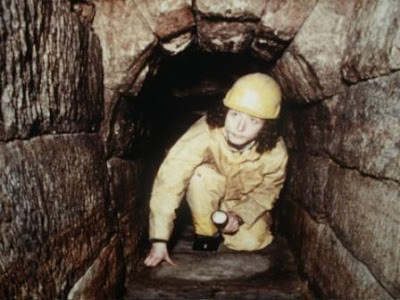
A happy archaeologist in a Roman sewer. Such an elevating profession!

The Roman Bath Museum
9 St. Sampson's Square
York YO1 8RN
01904 620 455


Related Reading
A Roman Moment
Wasting Away: More Roman Bog Roll
Wasting Away: More Roman Bog Roll II
Roaring Good Roman Fun
Hypocausts - A Hot Topic!
The Finer Points of Roman Hygiene
Nunc Est Lavandum - Bath-Time!
Related Posts Plugin for WordPress, Blogger...